Main Partner


30.10 – 1.11.2026
INTERNATIONAL FAIR OF CONTEMPORARY ART TORINO
Main Partner
An exploration in perspective, guided by artists, on the possibilities of our species to coexist with others. From self-perception to the overcoming of hierarchal logics.
Tappa 01
Corridor Fuxia 12
01.48
Tappa 02
Corridor Yellow 11
04.48
Tappa 03
PF 3
07.33
Tappa 04
D 3
10.32
Tappa 05
Corridor Dark Blue 4
13.26

Step 01, Pipeline, Giorgio Van Meerwijk

Step 01, Pipeline, Giorgio Van Meerwijk

Step 02, Blue Velvet, Mónica Mays

Step 02, Blue Velvet, Mónica Mays

Step 03, UNA, Valentina Furian

Step 03, UNA, Valentina Furian

Step 04, Les Filles du Calvaire, Karine Rougier
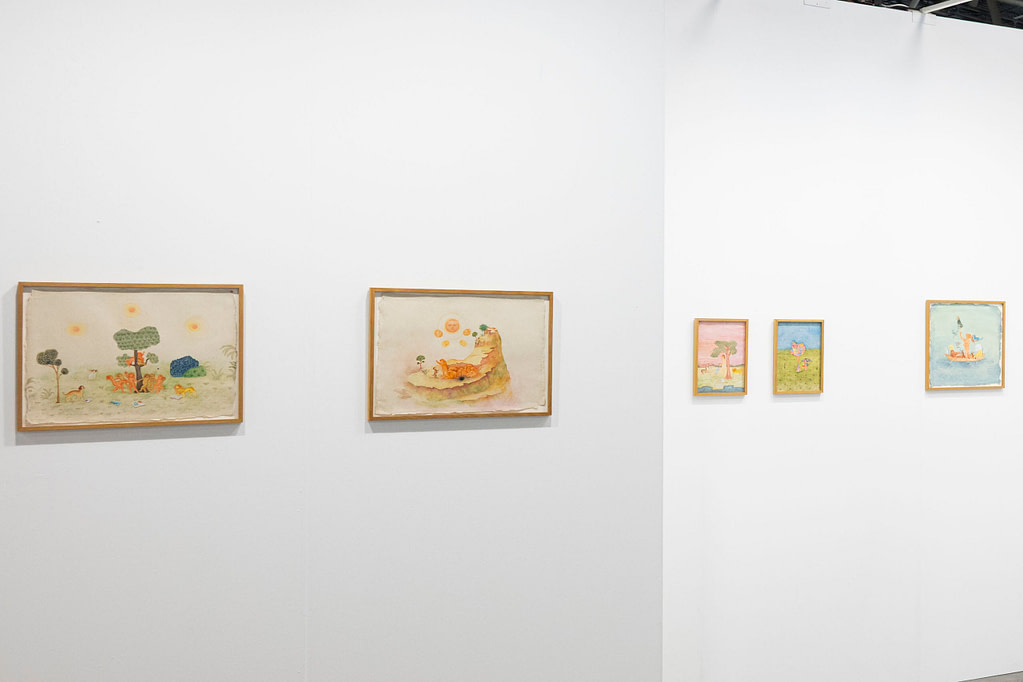
Step 04, Les Filles du Calvaire, Karine Rougier

Step 05, Zilberman, Yaşam Şaşmazer

Step 05, Zilberman, Yaşam Şaşmazer
Step 01
Corridor Fuxia 12
01.48
Step 02
Corridor Yellow 11
04.48
Step 03
PF 3
07.33
Step 04
D 3
10.32
Step 05
Corridor Dark Blue 4
13.26
Step 01, Pipeline, Giorgio Van Meerwijk
Step 01, Pipeline, Giorgio Van Meerwijk
Step 02, Blue Velvet, Mónica Mays
Step 02, Blue Velvet, Mónica Mays
Step 03, UNA, Valentina Furian
Step 03, UNA, Valentina Furian
Step 04, Les Filles du Calvaire, Karine Rougier
Step 04, Les Filles du Calvaire, Karine Rougier
Step 05, Zilberman, Yaşam Şaşmazer
Step 05, Zilberman, Yaşam Şaşmazer
Good morning! Welcome to Artissima 2025. This is the AudioGuide project and you are listening to tour number 4, entitled "Che Specie? - What Species?". Through five distinct artistic practices, we’ll explore the complex relationship between humans and other living beings. We’ll trace how this relationship has evolved over time — from a more balanced exchange to a reality dominated by anthropocentrism. The works in this itinerary offer a critical gaze on the power dynamics and speciesism that define our era, highlighting how human choices impact the environment and other forms of life. Yet, this journey also opens the door to imagination. The participating artists invite us to envision alternative worlds — places where interspecies relations can be rethought and reinvented, suggesting a possible post-humanism built upon new forms of coexistence and a renewed role for humankind within an interconnected system. Prepare for a journey that encourages us to reflect on our presence on this planet — on the history and evolution of our shared existence with other life forms — and to imagine a collective, sustainable future. The AudioGuides were developed for Artissima by the advisors of Arteco. This route was curated by Valentina Cortese. We are ready to go. Pause your player and head for the New Entries section, where our tour will begin. You will find the Pipeline gallery stand along the lilac corridor at number 12. Press play once you are there.
We begin our journey in the New Entries section, dedicated to emerging galleries that have been open for less than five years and are participating in Artissima for the first time. Among them is Pipeline, a London-based gallery founded in 2022, which adopts an innovative curatorial format. In its London venue, the main room hosts the exhibition of the current artist, while the back room — called the pipeline — features a single work chosen freely by the artist who will be the focus of the next exhibition. For Artissima, Pipeline dedicates its stand to Giorgio Van Meerwijk, born in Toulouse in 1998 and currently based between Paris and London. His practice, primarily sculptural, brings together diverse — often found — materials and explores the relationship between nature and human culture. In particular, the artist focuses on the impact that folklore and popular traditions have had on our connection with the environment. The group of works presented here draws inspiration from the history and uses of St John’s Wort, a plant surrounded by popular beliefs and long used for medicinal purposes. According to the Doctrine of Signatures — an ancient theory that Van Meerwijk researched during his residency at the British School at Rome — every plant bears within its form the “signature” of the body part it can heal. The tiny perforations on the leaves of St John’s Wort, for example, were thought to correspond to the “openings” of the skin, which is why it was used to treat wounds. On the wall, we find a large photographic portrait of the plant itself. Next to it, a series of stone reliefs depict the various traditional uses of St. John's Wort — for healing, as protection for travellers, or burned during the summer solstice. At the centre of the stand stands a sculpture made of concrete, reclaimed wood, brass, and natural materials. Entitled Teriaca, it refers to an ancient medicinal compound once believed to be a universal antidote. Van Meerwijk’s works speak to us of fragments of ancient knowledge and alternative ways of inhabiting the world. The artist brings us back to a time when humans sought connection with other forms of life, attributing to them powers, functions, and meanings — evoking a pre-Anthropocene world in which relationships with nature were guided by attunement to its rhythms and an understanding of its properties, prevailed over the logics of domination and power. A faint echo of a lost coexistence. We finished our first stage. Pause your player and head for the yellow corridor. At stand number 11 you will find the Blue Velvet gallery. Press play once you are there. I will be waiting for you!
Our second stop takes us to Blue Velvet Gallery from Zurich, located within the Main Section of Artissima. Here we encounter the work of Mónica Mays, an artist born in Madrid in 1990, who now lives and works between the Spanish capital and Amsterdam. Her practice spans sculpture, installation, and performance, combining autobiography, observation of the world, and historical archives. Her works emerge from assemblages of diverse materials — domestic scraps, industrial remnants, natural and organic elements — which she reworks through processes of appropriation and transformation. The fusion between the artificial and the living lies at the heart of her research, where the industrial-organic hybrid becomes a tool to explore the dynamics of coexistence between the human and the natural. At Artissima, the artist presents two works that recall the logic of the taxonomic drawers found in natural history museums. Traditionally made of wood, these containers were used to classify and order insects or small specimens according to a strict, scientific, and hierarchical system. Mays disrupts that rigidity by parasitising the drawers: inside several compartments she places cocoons of the silkworm, Bombyx mori — a species that, after centuries of exploitation in textile production, has been rendered blind and flightless. The cocoons on display here come from silkworms bred by the artist herself, which, once hatched, were released back into nature. In the work from her Shadow Box series, a layer of silk wraps around the wooden container, onto which Mays has transferred images of flowers and plants using a natural printing technique. In the sculpture She watched the bar of Time, which broke, the taxonomic drawers appear in a rougher state, and the artist incorporates the element of a conveyor belt — a clear reference to Fordist production lines and a further symbol of human efficiency and dominance over nature. Finally, at the centre of the stand stands a sculpture that combines a rusted drainpipe with organic and natural materials. In this assemblage, matter itself seems to lose momentum, evoking an exhausted force — a metaphor for power dynamics that have run their course and faded away. This is where our second stop ends. Pause your player and head for the UNA Gallery in the Present Future section, on the black corridor, at stand PF 3. Press play once you are there. I will be waiting for you!
We’re now standing before UNA Gallery, in the Present Future section curated by Artissima. Founded in 2018 in Piacenza, UNA promotes emerging artists born in the 1980s and 1990s, and was created by its founders with the aim of developing an independent research platform. For Artissima 2025, UNA presents Sentinelle — an immersive installation by Venetian visual artist Valentina Furian, born in 1989. Her work spans film, performance, photography, and drawing, investigating interspecies relationships between humans and the animal world — relationships that, according to the artist, are complex, often conflictual, and marked by dynamics of power and domination. Sentinelle is conceived as a nocturnal journey — one to be experienced with the senses before the intellect. In nature, darkness provokes unease and fear: our pupils dilate, our senses sharpen, and our bodies prepare to defend themselves. Here, it is the colour red that guides us — the same tone used in night-vision goggles, which allows us to see without blinding. As often happens in Furian’s work, the human figure is almost absent. The protagonist is the horse, depicted in drawings on paper and on plexiglass panels positioned at the centre of the room. Among the first animals to be domesticated by humans, the horse becomes a symbol of humankind’s dominance over other species. From the Latin domesticus — “of the home” — domestication is the process through which humans have made nature docile and dependent. In the transition from wild to domesticated animal, an in-between figure is born — one the artist calls “monstrous”. It is an act of possession to which, Furian suggests, humans have also subjected themselves: by creating rules and social constructs, we have stripped away what is instinctive and feral within us. Thus, even if the human figure is absent, everything here speaks about us — about our need for control, our hierarchies of power, and our relationships with other living beings. Following with our gaze the fragmented red lines of the horses in the foreground, we reach Eclissi, a two-channel video projecting Antonio Canova’s Head of Medusa, held at the Gipsoteca in Possagno. With her serpent hair, boar tusks, and gilded wings, Medusa is another hybrid creature — half human, half animal. Her petrifying gaze seems to have struck the horses at the heart of the installation, fallen asleep under her spell and trapped in an eternal game of predator and prey. We finished our third stage. Pause your player and head for the Disegni section. You will find the Les Filles du Calvaire gallery at stand number 3. Press play once you are there. I will be waiting for you!
Our journey continues in the Disegni section which, together with Present Future and Back to the Future, is curated by Artissima — the only fair to have dedicated a space entirely to drawing, fully recognising its value and autonomy as a medium. The Paris-based gallery Les Filles du Calvaire presents a solo exhibition by Karine Rougier, a French artist who grew up between Malta and the Ivory Coast and descends from four generations of painters. Now living and working in Marseille, her Mediterranean upbringing continues to nourish her imagination and artistic practice. At Artissima, the artist presents twelve new works on ancient handmade paper, executed in graphite or watercolour with natural pigments. Fantastic creatures, men with moon-shaped heads, mermaids, cherubs, chimeric beings, and unknown celestial bodies: before us unfolds a dreamlike universe in which humans and animals merge and intertwine freely, within a fairytale nature that is not merely a backdrop but a living organism in constant transformation. The small scale of the drawings, their rich detail, and the tactile quality of the paper create an intimate, almost sacred dimension — as if before the viewer, the doors of a secret world were quietly opening. To construct her imagery, Rougier draws from a wide range of sources: from mythology and traditional fables to illuminated manuscripts and modern philosophy, from medieval art to Indian miniatures. She also takes inspiration from memories of her Mediterranean childhood and from collections of cherub images passed down by her grandfather. There are no boundaries, rules, or hierarchies: her work moves through free associations, guided by an almost pantheistic vision in which everything seems to flow within a single, ever-transforming world. Alongside the watercolour series is a group of graphite drawings on handmade Nepalese paper. Unlike the former — more precise and studied — these pieces arise from spontaneous, gestural movements: through a process of subtraction, unexpected forms emerge, offering us a direct glimpse into the artist’s fantastic inner world. In the face of a fearful reality and a planet in crisis, Rougier proposes an idyllic, hope-filled world — a refuge in which to celebrate harmony among all species and the bonds that unite them. Not an anthropocentric world, but a galaxy of relationships, where every form of life is part of a single, interdependent ecosystem. We have finished our fourth stop. Pause your player and head for the blue corridor. At stand number 4 you will find the Zilberman gallery. Press play once you are there. I will be waiting for you!
Our final stage brings us back to the Main Section of Artissima, at the stand of Zilberman Gallery. With its three locations in Istanbul, Berlin, and Miami, Zilberman has, since 2008, fostered an open dialogue between artists of different cultures and generations. We pause here to explore the work of Yaşam Şaşmazer, one of the most significant voices in contemporary Turkish art. Born in Istanbul in 1980, she now lives and works between Berlin and her hometown, creating sculptures and installations with natural materials. At Artissima, she presents a body of work from the series Seeds and "Studies for Potential Metamorphoses", produced between 2023 and 2025. Şaşmazer’s practice has evolved through several phases. She began in the early 2000s with wooden sculptures of children and adolescents, exploring inner conflict and the realm of the subconscious. Over time, the human figure has gradually dissolved, becoming unrecognisable. Today, her works depict organisms in metamorphosis — bodies merging with soil, moss, fungi, and other natural elements. Starting from an interest in the inner world, the artist has widened her gaze to question the meaning of being human within a world shared with plants, animals, and other species. Moving beyond an anthropocentric perspective, Şaşmazer proposes a non-hierarchical vision in which every form of life is part of a single ecosystem. The bodies in her works are not closed structures but entities in constant transformation — open to encounter, ready to merge with other living beings. Among the works on display, the Seeds series comprises ceramic and stoneware sculptures alongside watercolours on paper. Their circular forms recall shells, seeds, or cells in transformation — evoking birth, growth, and the continuous cycle of life. The surfaces are often marked by fissures — not wounds, but openings, thresholds toward the world. In the "Studies for Potential Metamorphoses" series, the human figure dissolves even further. The sculptures show faceless bodies that bend, open, and shift form. There is no suffering here — only gestures of openness towards the Other. In a historical moment defined by ecological crisis, Şaşmazer’s work invites us to imagine the world not as a sum of separate elements, but as a collective organism in perpetual transformation. Her forms, poised between the human and the non-human, remind us that we too are part of this ecosystem. We finished our fifth and final stop. We hope that this course has stimulated and intrigued you. If you’d like another perspective on the art fair, go back to the info point or the AudioGuides landing page and select another podcast! See you soon and enjoy Artissima!
