Main Partner


30.10 – 1.11.2026
INTERNATIONAL FAIR OF CONTEMPORARY ART TORINO
Main Partner
The evocative power of the sign, the image and the gesture as a field of research among practices that explore the human ability to imagine and the capacity of art to allude and transfigure.
Tappa 01
Corridor Fuxia 9
01.24
Tappa 02
Corridor Red 7
04.00
Tappa 03
Corridor Dark Blue 15
06.23
Tappa 04
BTTF 3
09.10
Tappa 05
PF 1
11.51

Step 01, Bliss, Urszula Broll

Step 01, Bliss, Urszula Broll

Step 02, Matèria, Karen Knorr & Maïmouna Guerresi

Step 02, Matèria, Karen Knorr & Maïmouna Guerresi
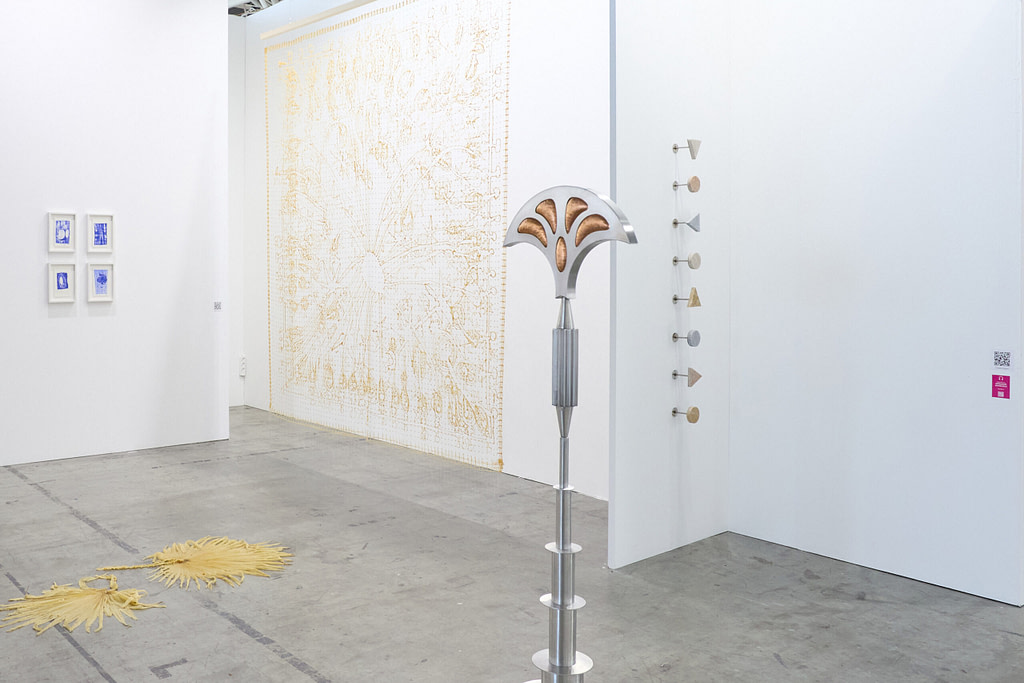
Step 03, Foco, Clara Imbert & Manon Harrois

Step 03, Foco, Clara Imbert & Manon Harrois

Step 04, Danielian, Manuel Messias dos Santos

Step 04, Danielian, Manuel Messias dos Santos
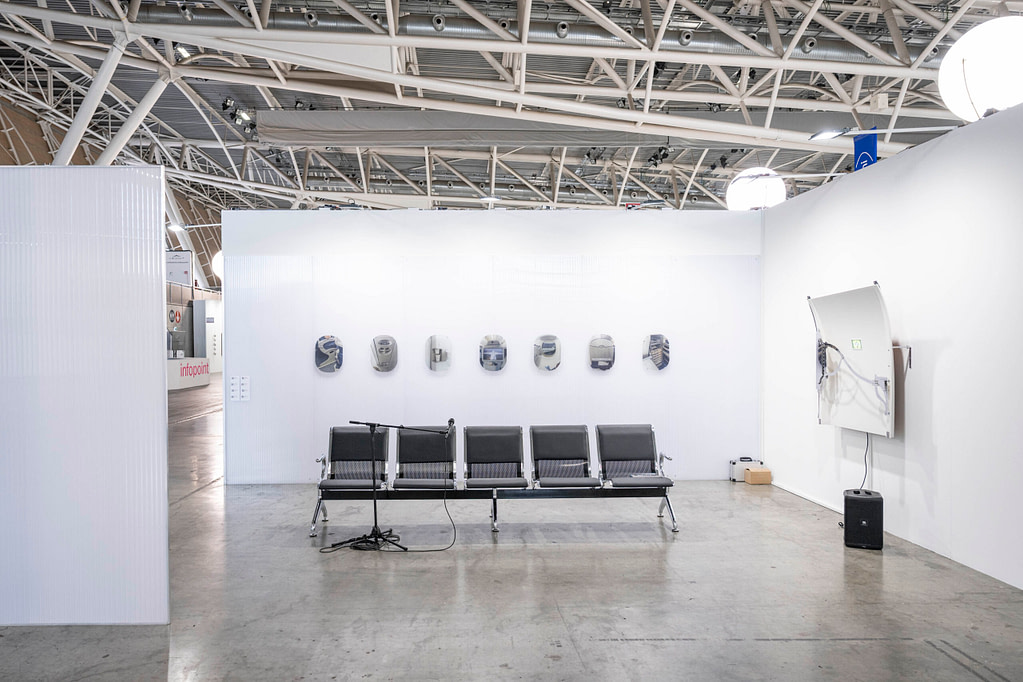
Step 05, Max Goelitz, Ju Young Kim

Step 05, Max Goelitz, Ju Young Kim
Step 01
Corridor Fuxia 9
01.24
Step 02
Corridor Red 7
04.00
Step 03
Corridor Dark Blue 15
06.23
Step 04
BTTF 3
09.10
Step 05
PF 1
11.51
Step 01, Bliss, Urszula Broll
Step 01, Bliss, Urszula Broll
Step 02, Matèria, Karen Knorr & Maïmouna Guerresi
Step 02, Matèria, Karen Knorr & Maïmouna Guerresi
Step 03, Foco, Clara Imbert & Manon Harrois
Step 03, Foco, Clara Imbert & Manon Harrois
Step 04, Danielian, Manuel Messias dos Santos
Step 04, Danielian, Manuel Messias dos Santos
Step 05, Max Goelitz, Ju Young Kim
Step 05, Max Goelitz, Ju Young Kim
Good morning, and welcome to Artissima 2025! This is the AudioGuide project, and you are listening to tour number 3, entitled "Orizzonti simbolici". This trajectory, comprising five stages, traverses works that invite us to question our gaze, to dismantle perceptual automatisms with attention and resistance. Some practices precede the hyper-connected era we inhabit, others are born within it. In all of them, there is a desire to broaden perspectives and to resist the temptation to simplify the world. The works you will encounter inhabit a liminal space, between what we see and what we intuit: a territory where the sign becomes knowledge, the gesture becomes freedom, and the image becomes transformation and movement. The AudioGuides were developed for Artissima by the advisors of Arteco. This route is curated by Valentina Roselli. Pause and head to the Bliss Gallery, in the New Entries section, Fuchsia corridor, number 9. Press play once you are there.
The first stage takes us to the New Entries section with the Bliss Gallery in Warsaw, showcasing a key figure in the Katowice underground scene: Urszula Broll, an artist who traverses the twentieth century between avant-garde, spirituality, and inner exploration. In the 1950s, in an industrial Silesia after the war, Broll studied poster art and graphics at the Academy in Krakow. She paints factories, still lifes and portraits of women in a world of coal and toil. In 1953, she co-founded the St-53 group, among the first to distance themselves from socialist realism, paving the way for abstraction and the freedom of the sign. Amidst an environment dominated by propaganda art and a strongly masculine culture, her free and spiritual choice is a radical gesture of independence. During the 1960s, as Polish art navigated between Warsaw, Krakow, and Katowice, Broll embraced watercolour as the most personal expression of her practice. Created in moments of silence, between caring for the child and working in the studio, these sheets come into being as spaces for introspection. 'I create to discover what I still don't know about myself', she wrote. In the pauses, while the colours dry, the painting becomes meditation. The shapes, from being free, become more and more geometric. In 1960, along with Andrzej Urbanowicz, she founded the studio on Piastowska Street in Katowice, from which Oneiron, 'the place of the dream', would emerge: an avant-garde laboratory and the first centre for Zen Buddhism in Poland. In that context, somewhat peripheral but profoundly free, Broll intertwines Eastern philosophy, Jungian psychology, and artistic research, giving shape to a language of consciousness. In the eighties, she retired to the Karkonosze mountains, where she founded a Buddhist community and continued to paint until the end. Her watercolours, rare but consistent, become mystical portals. The circle is her constant sign, a daily exercise of attention and concentration. In the noise of our time, Urszula Broll's painting asks us to slow down our gaze. Attention, as her practice teaches, is first and foremost a form of freedom and resistance. The next stop will be the Matèria gallery, in the Main Section, Red corridor, number 7. Pause and press play when you are there.
The second stage brings us to the Main Section at the Matèria Gallery in Rome, where Karen Knorr and Maïmouna Guerresi bring two complementary visions into dialogue. Distant geographies and diverse languages meet in the urgency to use the image as a tool to investigate the relationship between body and architecture, power and vulnerability. Karen Knorr, educated in 1970s London, in dialogue with feminism and cultural studies. From the beginning, her photography analyses the social architectures of privilege and the aesthetic codes of power. In the early 1990s series entitled Capital, she explores the City of London as the stage for global capitalism, where immaculate spaces and status rituals become the backdrops for an authority that legitimises itself through beauty. The photographic work titled "The Principles of Political Economy", captured at the Bank of England, stands as an elegant and disquieting memento mori of modernity: it unveils a normally inaccessible setting, anticipating the collapse of the economic system and the fragility of its foundations. Maïmouna Guerresi interweaves spirituality and universal symbols, combining humble materials and sacred symbols. The body is a bridge that traverses metamorphosis and reconciliation. The 2025 work, "Eid al-Adha" (Festival of Sacrifice), is composed of ceramic tiles shaped like women's tank tops, arranged in a rigorous grid. It evokes a domestic altar of care and sacrifice, but also the sterile order of a butcher’s shop: the metal tube with steel hooks suggests an imagery of violence and consumption. The reference to Abraham's sacrifice transforms into a meditation on the condition of women in a time dominated by oppression and greed. In Knorr and Guerresi's works, the gaze is revealed as a political act: a gesture capable of restoring the complexity of reality, removing it from any simplification. The next stop will be the Foco gallery, Monologue/Dialogue section, dark blue corridor, number 15. Pause and press play when you are there.
In the Monologue/Dialogue section with the Portuguese gallery Foco, the third stage brings together Clara Imbert and Manon Harrois: two young French artists who weave their reflections on matter and gesture into a sensitive and open dialogue. Entering the space, you can sense a silent and vibrant laboratory. Both artists, who have both been through the Battaglia Artistic Foundry in Milan, share the idea of manual craftsmanship as a practice of knowledge and transformation, exploring the intersection between material, perception, and the intangible. In Clara Imbert's sculptures, rigour and intuition merge in forms that seem to originate from civilisations suspended between the past and the future. Among the new works, a suspended and reflective sculpture evokes feminine forms and sensual materials, like a precious artefact. Other works, such as Runes and Le Gardien Silencieux, expand her research on portals and thresholds. Runes, in limestone and quartzite, is the symbolic key to Portal (2024), a monumental stainless steel sculpture installed in France. The same geometries fit together like a game, transforming the artwork into a code that opens access to another space, both real and mental. Manon Harrois focuses her research on the relationship between body, matter, and environment. During a residency in Portugal, she collaborated with a community of fishermen, interweaving daily gestures and natural processes into a dialogue with the sea and its rhythms. From this experience emerges Tes yeux bleus ont pris la mer, a large sculpture in latex and cotton thread, made entirely by hand. The shape is reminiscent of a fishing net and, at the same time, a design suspended in the air. The weaves are drawn from the visual diaries the artist has maintained for over fifteen years: an archive of gestures and thoughts that here becomes an affective and spatial language, capable of giving form to the invisible. For the first time, the drawing emerges from the diary and becomes three-dimensional: a score in the space between presence and absence. Latex, like a second skin, retains the imprints of time and breathes like a living organism, evoking intimacy and landscape, vulnerability and memory. In dialogue, the two artists invite us to recognise how each mark left on the material holds knowledge, time, and a possibility of relationship. The next stop will be the Danielian gallery, Back to the Future section, lilac corridor, number 3. Pause and press play when you are there.
The fourth stage of the journey takes us to Back to the Future with the Brazilian gallery Danielian, presenting a project dedicated to Manuel Messias dos Santos, who died in Rio de Janeiro in 2001. A radical and introspective artist, he transforms the sign into a language of knowledge and freedom, giving voice and image back to those who have been left on the margins of history. Raised amidst the poverty of the Northeast and the favelas of Rio, Manuel Messias dos Santos channels his life journey into visual storytelling that merges pain and redemption. Thanks to his mother, a central figure in his life, who worked as a maid in the homes of the cultural elite, he was able to attend Ivan Serpa's courses at the Museum of Modern Art in Rio, a key intersection of Brazilian modern art. There he discovers woodcut, a direct and physical technique, in which engraving becomes gesture, word, liberation. His language arises from the encounter between expressionism and the tradition of popular cordel, illustrated booklets from the Northeast comprised of essential images and oral narratives. Building on these roots, the artist crafts a symbolic and allusive code that reflects the tensions and wounds of the military dictatorship, without ever openly taking sides. At the end of the Sixties, with the "YUWW-EUNS" series, interpretable with the concept of 'Many me', he invented an independent language—a system of signs and sounds conceived to communicate what could not be said. A visual structure that becomes a weave of resistance, memory and prayer. Although a fervent reader, Messias finished primary school only at the age of thirty-three: this may be why writing, whether visual or verbal, became an act of emancipation for him. The "YUWW-EUNS" signs speak of the link between earth, body, and the divine, evoking an archaic and vital spirituality. In the Seventies, at the height of the dictatorship, the "Nossa" series adopted the tone of a manifesto: the square works reveal the fractures within society, while the vertical ones open a space for reconciliation, where the image acts as a bridge between the human and the sacred. In the work of Manuel Messias dos Santos, sign, imagination, and gesture preserve a complex memory and generate forms of freedom. The next stop will be the Max Goelitz gallery, Present Future section, black corridor, number 1. Pause and press play when you are there.
The fifth and final stage of our journey leads us to the Present Future section with the German gallery Max Goelitz. In this setting, the Korean artist Ju Young Kim, born in Seoul in 1991, develops an aesthetic of transit, rooted in her own life experience, where identities and boundaries become fluid and blurred. The installation becomes a space of anticipation and transition: amid semi-transparent panels and a bench, the journey unfolds as both a physical and mental experience, encasing Kim's works in a suspended time. On the walls, the glass works of the Cabin Temperature series meet in dialogue with A Green Door at the Butterfly House of the AEROPLASTICS series. In Cabin Temperature, Ju Young Kim transforms travel fragments, such as air vents, tables, and monitors, into icons of an experience suspended between standardisation and intimacy. Every image, framed like a window, reveals a view that is never clear: the glass, with its imperfections, distorts and shifts the vision, revealing the very fragility of seeing. Next to it, a fragment of airplane ceiling holds a small sculpture in coloured glass, modelled by hand. Behind, a flashing light turns on and off like a breath, suggesting presence and waiting. To complete the work, a laser-cut steel door adopts the style of a Viennese Art Nouveau handle: a decorative piece that reveals the subtle tension between function and illusion, typical of airport non-places. During Artissima, the presentation is accompanied by a sound performance conceived with writer and curator Guilherme Vilhena Martins, with whom Kim created the artist's book Air Conditioned Hours. The texts of the volume are disseminated as flight announcements, expanding the artist's sculptural language into a transient acoustic experience. Through Ju Young Kim's ability to transform contemporary mobility into artistic production via sensitive interventions, a poetic horizon opens: the gaze becomes movement, and the Earth itself a vessel on an endless journey. With this image, we say goodbye. We hope this journey has been inspiring. If you’d like another perspective on the fair, go back to the info point or the AudioGuides landing page and select another itinerary. See you soon, and enjoy Artissima!
